
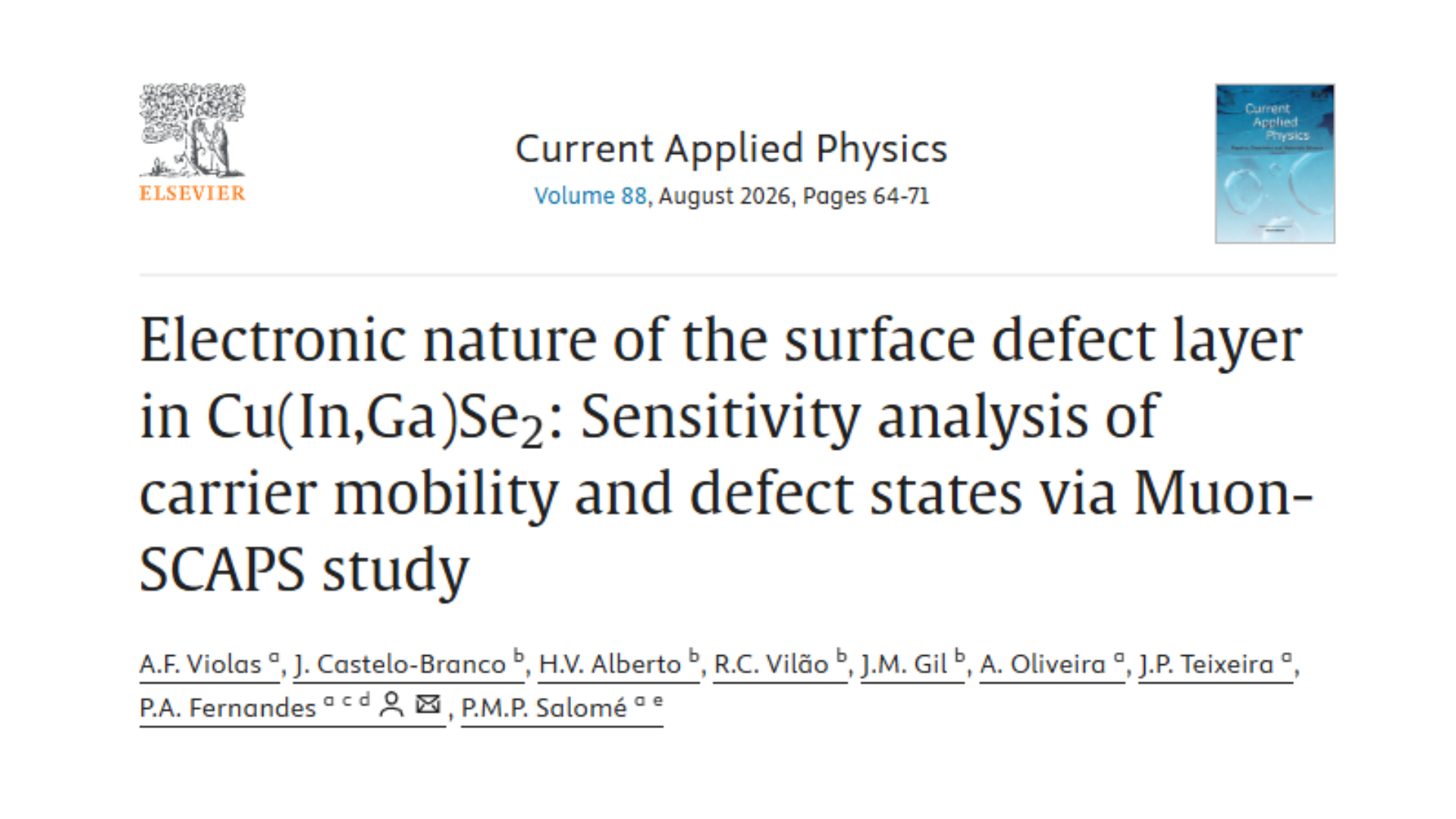
A new study led by researchers at the International Iberian Nanotechnology Laboratory | NOA, in close collaboration with the University of Coimbra, provides new insights into the fundamental properties of semiconductor materials used in high-efficiency solar cells.
The work, recently published in Current Applied Physics, focuses on Cu(In,Ga)Se₂ (CIGS),a leading thin-film photovoltaic technology, and investigates the role of defects at the material’s surface, a critical factor limiting device performance.
A Unique Collaboration Combining Advanced Characterization and Modelling
This study brings together INL’s expertise in device physics and modelling with the University of Coimbra’s leadership in muon spin spectroscopy (μSR)—a highly sensitive and non-destructive technique capable of probing materials at the nanoscale.
Using μSR, the team identified a previously elusive surface defect layer (~50 nm thick) in CIGS absorbers, characterized by strong lattice disorder and defect-induced strain . This region plays a crucial role in charge carrier recombination, directly impacting solar cell efficiency.
From Fundamental Physics to Device Performance
To understand how these defects affect real devices, the experimental μSR findings were combined with advanced SCAPS optoelectronic simulations. This integrated approach allowed researchers to establish a direct link between:
- structural disorder observed at the nanoscale,
- electronic defect properties, and
- macroscopic solar cell performance.
The study reveals that deep acceptor-type defects in the surface layer significantly reduce efficiency, primarily by increasing recombination losses and lowering the short-circuit current .
Importantly, the results also demonstrate that the commonly used CdS buffer layer effectively passivates these defects, reducing their density and mitigating their negative impact on device operation.
Muon Spectroscopy: A Powerful Tool for Energy Materials
The collaboration highlights the growing importance of muon spectroscopy as a powerful tool for semiconductor research. Unlike conventional techniques, μSR enables depth-resolved probing of defects and carrier dynamics, offering unique insights into buried interfaces that are otherwise difficult to access.
Towards More Efficient Solar Technologies
By bridging advanced characterization with device modelling, this work establishes a comprehensive framework to understand and control defect-related losses in CIGS solar cells. The findings provide clear guidance for:
- improving interface engineering,
- designing alternative buffer layers, and
- advancing next-generation high-efficiency photovoltaics.
This collaboration between INL and the University of Coimbra reinforces the importance of combining complementary expertise to tackle complex challenges in energy materials and semiconductor physics.
link to the article:
https://www.sciencedirect.com/science/article/pii/S1567173926001276?via%3Dihub