
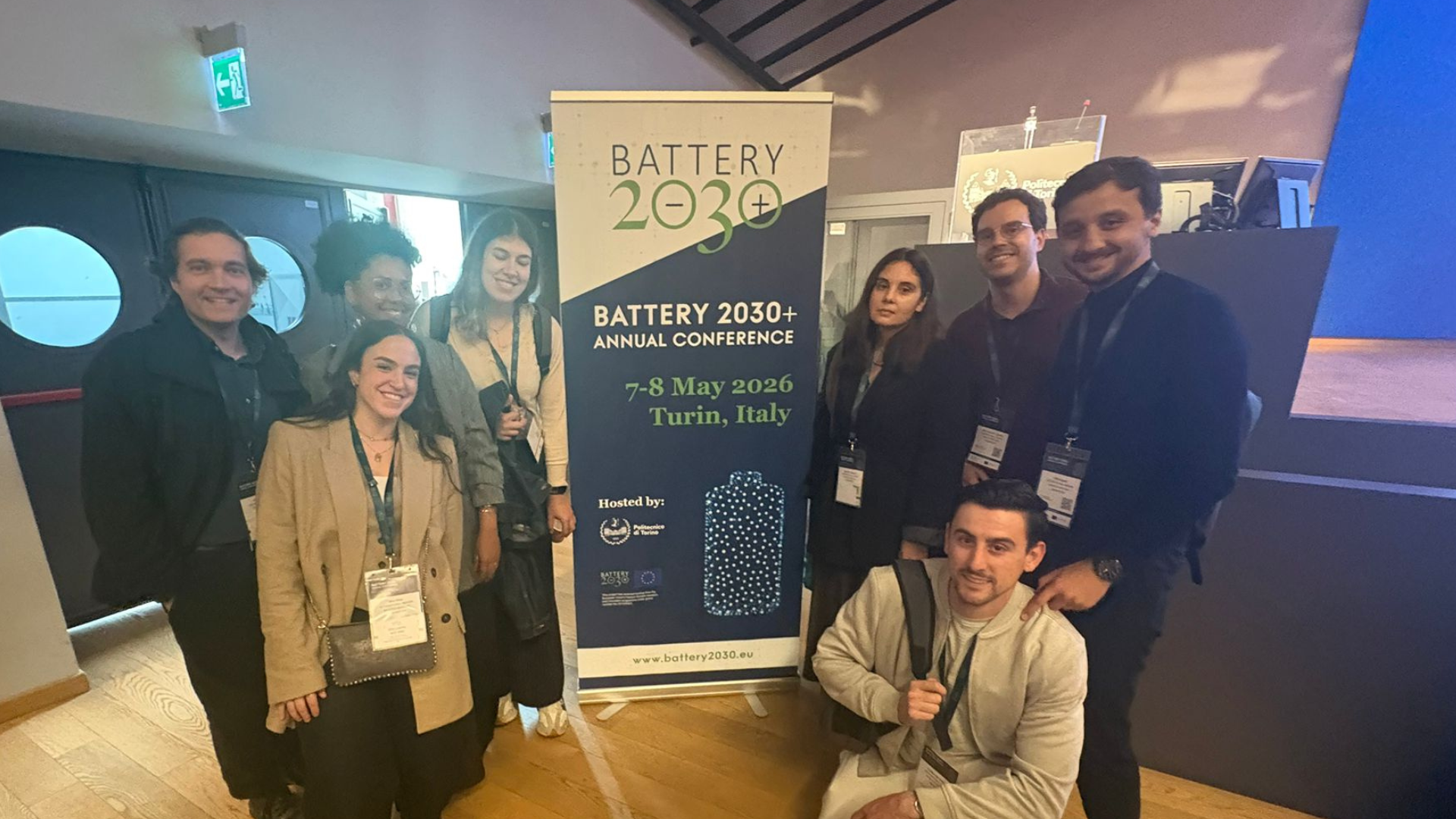
A delegation of eight researchers from the International Iberian Nanotechnology Laboratory (NOA group) participated in the Battery 2030+ Annual Conference 2026, held on 7–8 May 2026 in Turin, Italy.
The team actively contributed to the conference with four poster presentations and one oral communication, highlighting ongoing research within the NGS – New Generation Storage project and reinforcing NOA’s position in advanced battery materials, diagnostics, and energy systems integration.
Advancing Solid-State Batteries
The oral presentation focused on the development of Ni-doped Li₂ZrCl₆ solid electrolytes for all-solid-state lithium-ion batteries. The work demonstrated how material synthesis optimisation and cation substitution strategies can significantly influence ionic conductivity and electrochemical stability . This research addresses key challenges in solid-state batteries, including interface stability and scalability, contributing to safer and higher energy-density storage technologies.
Understanding Battery Degradation Mechanisms
One of the presented posters explored degradation mechanisms in lithium-ion batteries through a comprehensive post-mortem characterization approach. Combining SEM, XRD, XPS, and EDS analyses, the study showed that degradation is driven by:
lithium loss from cathode materials,
formation of complex solid electrolyte interphases (SEI), and electrolyte decomposition and transition metal migration .
These insights are essential for extending battery lifetime and improving recycling strategies.
Innovative Diagnostic Tools for Batteries
Another contribution introduced a model-free method for capacitance extraction from electrochemical impedance spectroscopy (EIS). This approach enables real-time identification of intercalation and interfacial processes without requiring complex equivalent circuit modelling .The method provides a fast and powerful diagnostic tool for assessing battery state-of-health and degradation pathways.
Linking Degradation to Electrochemical Signatures
A complementary study further demonstrated how capacitance-based analysis (Cg) can serve as a direct indicator of degradation, linking SEI evolution and active surface changes to battery ageing . This work highlights the potential for simplified, data-driven monitoring approaches in real-world battery systems.
Batteries in Future Energy Systems
The NOA team also presented work on the integration of batteries into Virtual Power Plants (VPPs). This research demonstrated how battery energy storage systems can:
- enhance grid flexibility and stability,
- enable participation in electricity markets, and
- support the large-scale integration of renewable energy sources .
- The study provides a framework for implementing VPPs in Portugal, addressing both technical and regulatory challenges.
Strengthening Collaboration and Visibility
Participation in the Battery 2030+ conference provided an excellent platform for:
- disseminating NOA’s latest research results,
- engaging with leading European battery initiatives, and
- fostering new collaborations across academia and industry.
This strong presence reflects NOA’s commitment to advancing next-generation energy storage technologies, from fundamental materials research to system-level integration.