
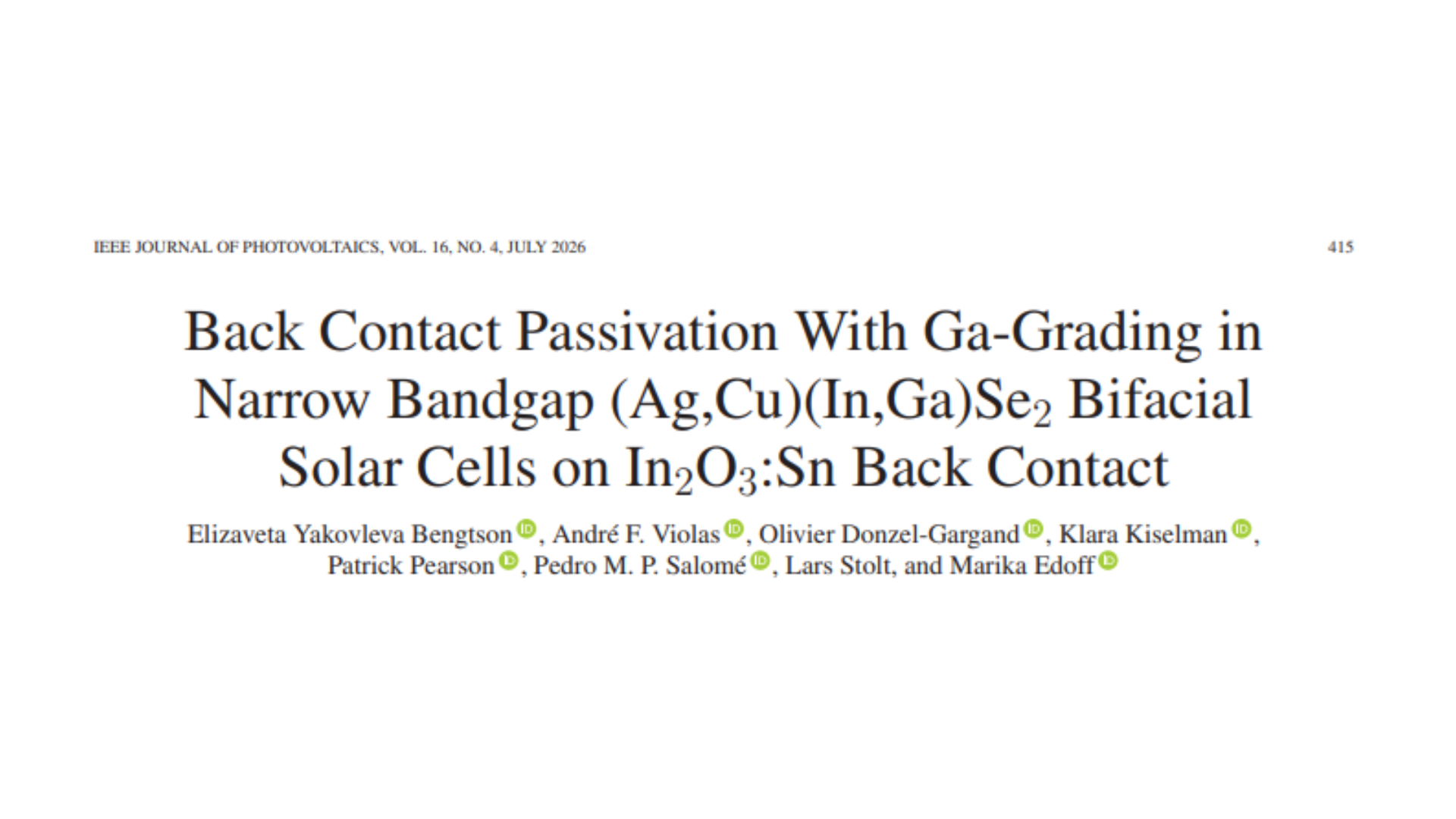
Researchers from the Nanofabrication, Optoelectronics and Energy Applications (NOA) Group at the International Iberian Nanotechnology Laboratory (INL), in collaboration with Uppsala University, have published new research in the IEEE Journal of Photovoltaics demonstrating an effective strategy to improve the performance of ultra-thin bifacial (Ag,Cu)(In,Ga)Se₂ (ACIGS) solar cells through advanced back-contact engineering.
The study investigates the role of gallium (Ga) grading and back-contact passivation in ACIGS solar cells fabricated on transparent indium tin oxide (ITO) substrates. The researchers show that carefully engineered Ga concentration profiles, combined with the formation of an ultrathin GaOx interfacial layer, significantly enhance carrier collection and reduce recombination at the rear contact. As a result, the devices achieved 15.2% conversion efficiency with up to 60% bifaciality, while demonstrating performance equal to or better than conventional molybdenum-backed devices.
The work also demonstrates that efficient rear-contact passivation can be maintained in sub-micrometre-thick absorbers, providing an important pathway towards lighter, more material-efficient photovoltaic devices without compromising performance. The findings further reveal how absorber thickness and Ga grading can be optimized to maximize both front- and rear-side energy collection, opening new opportunities for bifacial and semi-transparent photovoltaic technologies.
This publication aligns closely with the NOA Group's long-term research strategy on ultra-thin chalcogenide photovoltaics, where nanotechnology is used to engineer interfaces, light management structures, and passivation schemes that enable high-performance solar cells using significantly less semiconductor material. These developments support the transition from laboratory-scale concepts toward scalable manufacturing approaches for next-generation photovoltaic technologies, with potential applications in building-integrated photovoltaics (BIPV), tandem solar cells, and flexible energy harvesting systems.
The research was carried out within the framework of the Hi-BITS Horizon Europe project, strengthening the collaboration between INL and Uppsala University in the development of advanced thin-film photovoltaic technologies and reinforcing Europe's efforts towards sustainable, high-efficiency solar energy solutions.