
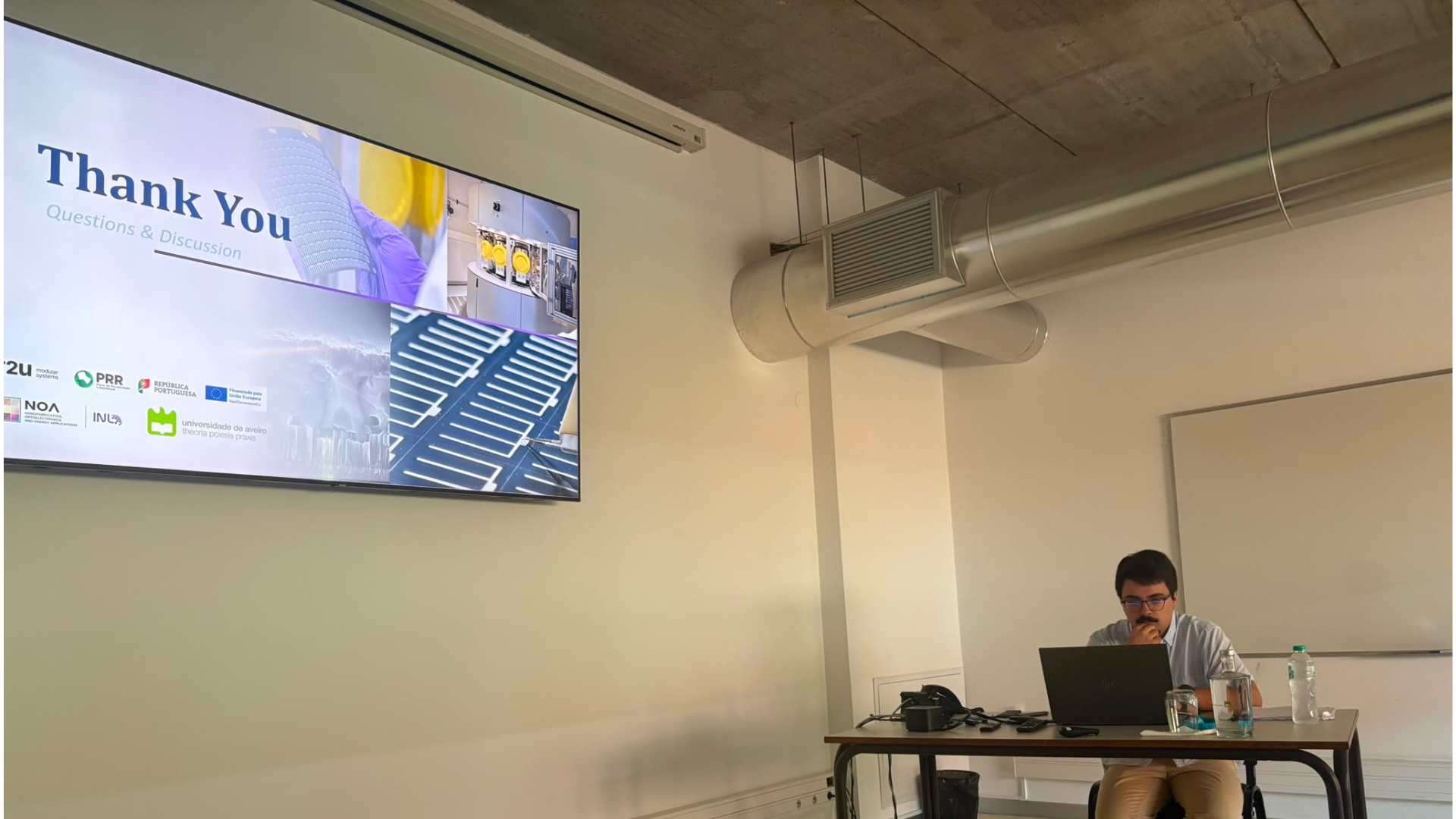
On 15 July 2026, João Vilão successfully defended his Master’s thesis at the University of Aveiro, marking the culmination of his work developed within the NOA research group at INL.
Entitled “Optimization of CIGS solar cells deposited by sputtering”, the dissertation was presented for the Master’s degree in Engineering Physics at the University of Aveiro, under the supervision of Pedro Salomé, from the University of Aveiro and INL, and António Oliveira, researcher at INL.
João’s research addressed an important challenge in thin-film photovoltaics: developing scalable and industry-compatible processes for high-performance flexible CIGS-based solar cells. While CIGS technology combines high optical absorption, a tuneable bandgap and the possibility of producing lightweight and flexible photovoltaic devices, transferring high-performance fabrication processes towards industrial manufacturing remains challenging. João explored the use of continuous-vacuum magnetron sputtering as a scalable alternative for CIGSSe solar-cell production.
A central part of his work focused on understanding how thermal management during and immediately after CIGSSe deposition affects device performance. João investigated different post-deposition cooling strategies, demonstrating that cooling under an H₂S-rich atmosphere can simultaneously limit chalcogen losses and preserve absorber quality. Using this approach, large-area devices reached an efficiency of 11.5%, representing an absolute improvement of almost 1.6 percentage points compared with the standard process.
The research also addressed the challenge of achieving homogeneous performance across larger photovoltaic areas. By optimizing the temperature profile during absorber deposition and studying processing conditions on devices with areas up to 220 cm², the work provided insights into how temperature influences crystallinity, material evaporation and spatial uniformity across the solar cell.
Overall, João's thesis demonstrates the importance of controlling both post-deposition cooling and deposition temperature to improve the performance and uniformity of sputtered CIGSSe solar cells, contributing to the development of scalable manufacturing routes for efficient flexible photovoltaics.
The work was developed with financial support from the R2UTechnologies – modular systems project, supported by the Portuguese Recovery and Resilience Plan through NextGenerationEU.
Congratulations to João on this important achievement and to his supervisors and all NOA colleagues who contributed to the work!