
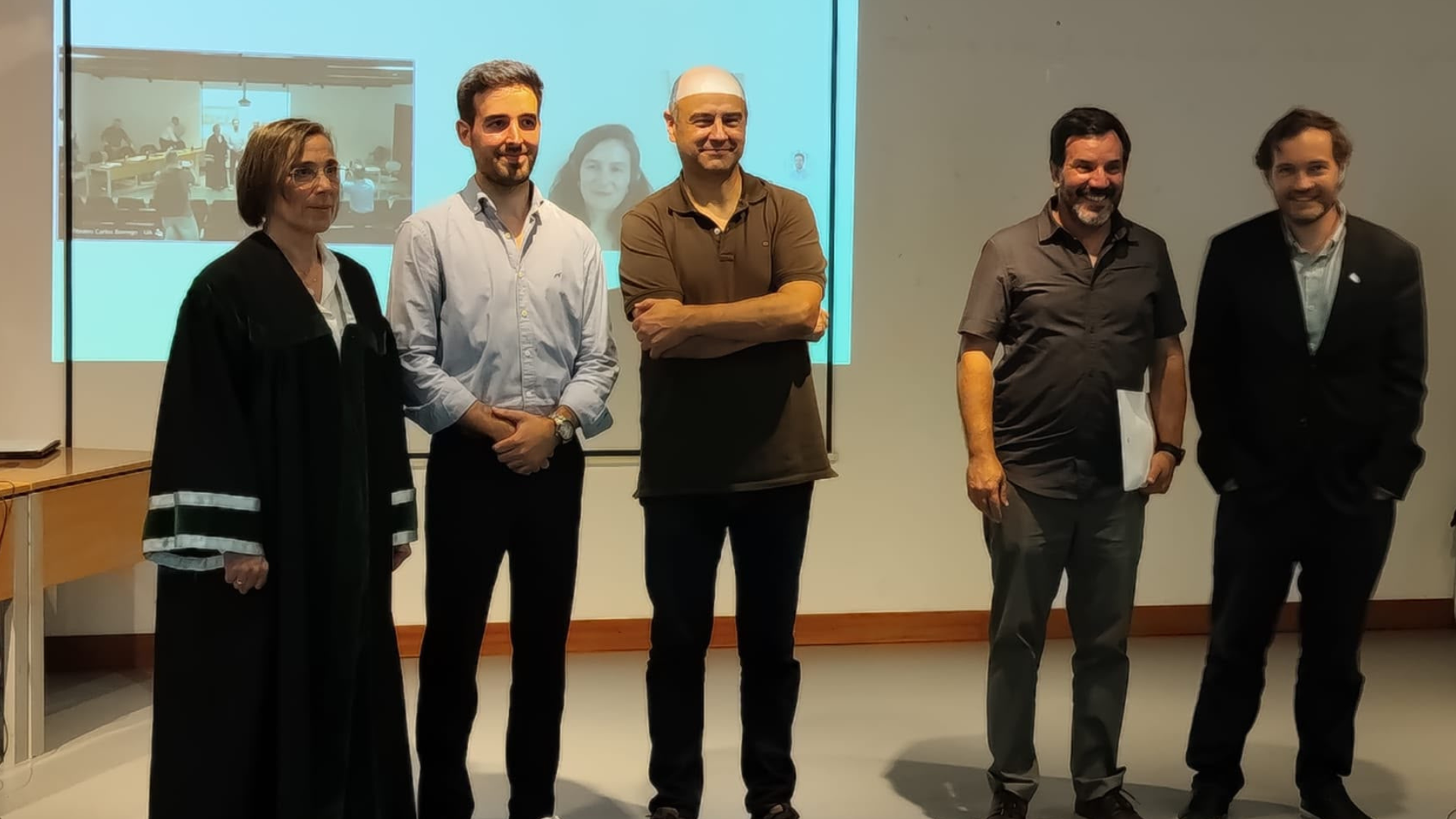
The Nanofabrication, Optoelectronics and Energy Applications (NOA) Group is proud to celebrate the successful PhD defence of Diogo F. Carvalho, who has completed his PhD in Physics Engineering at the University of Aveiro.
Diogo's doctoral thesis, "Exploring Plasmonic Strategies for Performance Enhancement in Perovskite Solar Cells," focused on advancing one of the most promising photovoltaic technologies of the next generation. His research explored innovative approaches to improving the efficiency and operational stability of perovskite solar cells through advanced interface engineering, plasmonic nanostructures, and electron transport layer optimization.
Developed jointly at the University of Aveiro, i3N, and the International Iberian Nanotechnology Laboratory (INL), the work reflects the strong collaboration between the institutions in advancing cutting-edge photovoltaic research. Throughout his PhD, Diogo carried out his research within the NOA Group, contributing to the group's activities in nanotechnology, thin-film photovoltaics, and advanced energy materials.
His research has already resulted in several high-impact scientific publications, including recent contributions that demonstrated new electron-sink mechanisms in perovskite solar cells and innovative nanostructured interfaces for enhanced photovoltaic performance. These achievements reinforce the NOA Group's commitment to developing next-generation solar technologies that combine scientific excellence with scalable manufacturing approaches.
Diogo's PhD was supervised by Professor Maria Rosário Correia (UA), Professor Paulo Fernandes (INL-NOA), and Dr. Manuel Martins (UA), with research carried out under the scientific environment of the NOA Group at INL.
The successful completion of this PhD represents another important milestone in the NOA Group's mission to train highly qualified researchers while advancing innovative solutions for the energy transition.
Congratulations, Dr. Diogo Carvalho, on this outstanding achievement! We wish you every success in the next stage of your scientific career.